12/23/10

"Rudolph the Red-Nosed Reindeer" and "One Flew Over the Cuckoo's Nest" Stick

On December 6, 1694, history became made with the release of the new film, “Rudolph the Red-Nosed Reindeer”. This classic Christmas movie follows the story of a misfit outcast reindeer with a blinking red nose that leaves his home and teams up with an aspiring dentist misfit elf, Hermey, and a gold seeking prospector, Yukon Cornelius. The trio takes on the Abominable Snowman, find an island of misfit toys whom they eventually save, and then help save Christmas as Rudolph becomes accepted and leads the sleigh through the storm with his blinking red nose. This classic story has proven as one of the most watched Christmas films and many families, such as my own, make it a tradition to watch this short and sweet story every year.

A few days ago my family indulged in this tradition as we all sat around in front of the television with eyes glued to the screen as the movie started. I began to enjoy the movie the same as every other year as the story progressed and suddenly the character Yukon Cornelius entered the scene as Rudolph and Hermey run across him and his dogsled as he searches the hills for silver and gold. This comedic, loud, red-headed prospector boldly introduced himself to the two misfits and then agreed to accompany them on their journey because of his claimed experience with the Abominable Snowman. With AP English constantly on the mind, I gasped and turned to my brother sitting next to me and excitedly proclaimed, “He reminds me of McMurphy!” My brother nodded acknowledging some of the similarities as I turned back to the screen excited to find other parallels between the characters.
Here is the list of what I came up with:
1. They both have crazy, red hair and large, strong bodies.
2. They both have an obsession with wealth. Cornelius searches the hills for silver and gold, and McMurphy constantly attempts to make money off people through gambling,
3.They both have strong personalities and lead other characters to eventual freedom in each story. Cornelius leads Rudolph and Hermey back to acceptance and the misfit toys to freedom, and McMurphy directly causes a change in the men that evokes personality shifts and freedom for many.
4. Cornelius forms the plan to stand up to the Abominable Snowman and he performs most of the fighting in the climax fight scene. McMurphy stands up to the Big Nurse and forms most of the plans of rebellion against her.
5.“Even among the misfits you’re a misfit”. Cornelius makes this assertion about himself and the other two main characters as he realizes their lack of a place in the world. This directly parallels McMurphy’s completely opposite personality from all the other men on the ward and still his inability to also become accepted in normal society. They have the same internal struggle.
    6.They both appear to die in the stories. After fighting the Abominable Snowman, Cornelius falls off the cliff and appears to die, but later he appears at Santa’s Castle alive and well. McMurphy does die at the end of the story in a physical sense, but his spirit lives on in the men and specifically Chief, showing how he truly did not perish.

This movie is loosely based on the 1939 poem, but the writer also added many characters, such as Yukon Cornelius, when making the film. These parallels between the characters seem a little too exact for pure coincidence, and perhaps the writer had a direct influence from One Flew Over the Cuckoo’s Nest (published in 1962, two years before the movie release date of 1964.)    

12/19/10

Stuck to AP English

Festivity and holiday cheer fill the room as I walk into Sammi's house and see christmas decorations everywhere. I walk into the kitchen as "the first noel" plays in the background and set down my pink weaver family cookies on the table with already six other trays of a variety of treats. Ugly Christmas sweaters surround me as we all look around at each other laughing and admiring how everyone went all out with the hilarious theme. From elf and santa hats, to funny Christmas socks, to sweaters that should probably be burned (mine as a perfect example), the bizarre apparrell walking around the room seems just plain wrong. So the conversation continues on and we talk about winter break plans, christmas traditions, funny stories as we all laugh and have fun. Then suddenly... it happens. AP English somehow creeps its way unto the conversation (as always) and everyone starts to talk about what they just blogged about today and how they are so bummed that we have to remember to do them over break. Time then suddenly stands still and the music seems to suddenly stop and everyone just looks at me in horror in the same way as if I had just admitted to some felony as I mutter in shock, "Oh no. I forgot to blog". Every AP English 12 student at first just lets out a chorus of "Oh.." and then they all start laughing as I ask in confusion the day of the week and continue to deny that this tragic incident actually just happened.

That illustrates the reason why I now sit upstairs in my friend's study room, type away on her computer, and listen to my friends laugh and yell right below my feet as I do homework. I feel like this depicts a perfect example of how insane all AP English students really act. I could have just stayed downstairs, ate cookies, played the games and just taken the hit on this blog post and finished it tomorrow. But no. Instead I have become brainwashed AP English to the point where we all obsess about our assignments so much that I feel like I could not disappoint Ms. Serensky and party with an unfinished blog post hanging over my head. Maybe the brainwashing does have some benefit, but it definitely also have some side effects that make us all sort of crazy to the point where we choose blogs over having a life. So as much fun as blogging can is, I guess I will go back down to the party now.

12/16/10

Scrutinizing The Sticky Ending


The bittersweet ending to this novel lead to me to reflect on the sad fact about the balance in the world and how some things must worsen for others to improve. This unfortunate fact became evident at the end when McMurphy dying for his cause provided the only way for Bromden to actually become free. This whole poetic ‘one person dying for another’s rebirth’ aspect struck me the wrong way at first when I read the ending, but the more I sat on it, the more I realized the truth in this sad fact. Without McMurphy giving his life to inspire courage into the patients, Bromden would have never gained the bravery to leave and venture out into the world again.

The idea of restoring balance again through McMurphy’s death and failure contrasted with Bromden’s ‘birth’ and success actually strangely relates to an experience I had at work today. As a waitress in a nursing home dining hall, I get the perk of talking to the residents and hearing about grandkids, life stories and relationship problems in addition to their normal issues with the soups and desires for new flavors of ice cream daily. Today I had the section of the dining room where Mr. Swank, a man whose wife fairly recently left Hamlet for the hospital, sits to eat dinner. After clearing his dish and setting down his usual pie and ice cream in front of him, I asked him in the habitual way how he was, and he then looked up at me through his oversizes glasses and answered in a more alert and honest way than normal, “Good, how are you?”. This may seem small and insignificant, but it made me pause a little because this does not depict his normal response to my usual question. Though it sadedens me a lot to admit, I feel that Mr. Swank almost has improved in his independence and his activity level in the nursing home has heightened in his wife’s absence. I feel that this is exactly the same situation that occurs at the end of One Flew Over the Cuckoo’s Nest as Bromden finally improves and moves on once McMurphy unfortuantely exits the picture. Sometimes for one person’s situaion to improve, such as Mr. Swank’s or Chief Bromden’s, another person’s must worsen, such as Mrs. Swank’s or McMurphy. Though I hope that Mrs. Swank becomes healthy and returns, comparing this situation to the novel helped me to remove my anger and unrealistic hope for a happy end to the book, and accept the conclusion through realizing the truth in it. 

12/12/10

Random Pasted Image or Relevant Book Cover?


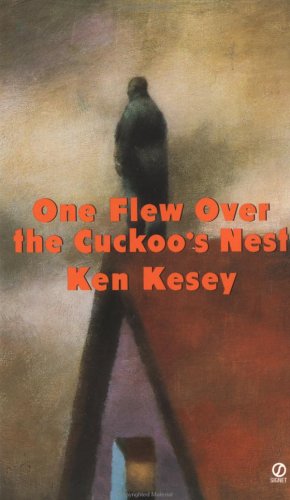
After finishing the reading, I began pondering what topic to blog about as I closed the book and walked over to my computer. I sat down in the chair, placed the novel on my desk, and stopped for a moment as I glanced down at the image staring up at me. I suddenly realized that I had never truly seen the cover of this book. Well, of course I had seen the cover before, but I had definitely failed to ever give the artwork any second thought or consideration before diving in. It seems absolutely insane that I could give so much effort into analyzing and attempting to understand this book without ever even thinking about the only visual aspect provided.  I continued to examine the picture and I became puzzled that the image remained ambiguous and confusing to me despite the fact that I have read over half of the novel it pertains to. The shaded figure facing away perplexes me the most because the large body shape leads to believe it does not depict the narrator, but the lack of hair leads me to believe it also does not depict McMurphy. I do not feel that any other characters have made a large enough impact in the course of this book to make it on the cover, so I am at a loss for whom the figured depicted could represent. Also, the figure stands on top of what looks more like a house or cottage than a mental institution. In my mind the hospital looks more prison-like with a flat, dark gray roof, than a welcoming home with purple, orange and blue. The ward displays the only setting so far in the novel, so I really fail to understand the structure’s relevance to the story. The only aspect of the cover that I slightly understand depicts the figure’s precarious position on top of the pointed roof. This may potentially symbolize the fearful tone throughout the entire book and also evokes an uneasy feeling in me as I worry if the figure will fall or jump off. Also, the figure looking away into the distance elicits a longing feeling that I also feel fits this novel and some of the patient’s wishes to become accepted in society and flee the ward. Overall, this cover still provides considerable confusion and I wonder if the remainder of the book will further explain the images. Or perhaps I am acting crazy and looking too much into it. 

12/9/10

Thank Goodness the Ice Pick Trick Failed to Stick

A few days ago our class became enthralled in a brief and heated discussion on how perhaps we cannot consider the “inhumane” treatments in this novel actually as horrible as they seem because of the time frame and the difference in science between then and now. Despite the fact that I think the Big Nurse acts inhumanely harsh and condescending towards the men at times, I do agree that our ability to grasp this novel may become hindered by our lack of understanding of modern psychiatric science during that time. Even with our brief research on this era, I still feel that no matter how many facts I learn, I struggle to comprehend how medical professionals of the time believed that severing the brain in half with an ice pick actually solved mental problems.

I now realize that my inability to grasp this concept has lead me to feel overly angry with the establishment and defensive of the patients in this book. In an attempt to prevent myself from further skewing the characters in my eyes, I decided to further research the shocking medical procedure of trans-orbital lobotomies that became so famously popular in this time.

These depict just a few of the shocking facts that I found and that I feel help me overcome my disgust and realize how commonly this disturbing procedure occurred:
-In the post-war years between 1939 and 1960, tens of thousands of people were lobotomized in the United States and several other countries.
-The whole procedure only takes three-four minutes and often done hastily and without much preparation.
-For a full one third of patients, the lobotomy had absolutely no effect, and for another third, symptoms actually grew worse. The lobotomy procedure is now known as “one of the most barbaric mistakes ever perpetrated by mainstream medicine.” (American Experience)

This video from PBS gives a complete background and significance of trans-orbital lobotomies and I feel helped me gain understanding of the procedure and psychiatric care of the time period of our novel.
http://www.youtube.com/watch?v=_0aNILW6ILk

12/5/10

Society's Sticky Spot


“Society is what decides who’s sane and who isn’t”(49). This assertion that the narrator boldly states in the beginning of One Flew Over the Cuckoo’s Nest made me pause while reading, and dwell for a moment on the implications.  I believe that this honest, forthright comment speaks the truth and its seemingly insignificant placement in the novel made it impact me greatly.
 Throughout history, many people have wrongly faced consequences of society’s disapproval of their beliefs and have become branded with the label “insane” simply because they failed to meet a certain set of vague standards. Standards which society feels they must enforce in an attempt to keep order and understanding of what it means to have sanity. To me, this seems extremely contradictory because no one truly has the ability to define what a sound, sane mind should or should not believe.  If we did understand this then why were innocent, sane women killed during the Salem Witch Trials because of accusations and Galileo rejected for his accurate heliocentric beliefs? Society tends to place negative focus on those with varying opinions or differing lifestyles than the average person, leading in many cases to false labels and allegations.
 Reading this statement reminded of a story my mom told me about her residency in medical school when she had to spend a serious of sessions shadowing psychologists while earning her degree. She told me once of this one schizophrenic patient that she had a session with who had believed half the time that he embodied Abraham Lincoln. When first hearing this man’s situation, most people automatically brand him as insane and in need of serious medical treatment. This brand leaves no room for the possibility that perhaps he has sanity in relation to his reality of the world, just not in the average perception of the world. Just as Galileo saw the world completely different than anyone else, maybe this man did depict Abraham Lincoln in his own reality…and who can actually define reality? What if society has the ideas of sanity and insanity completely wrong and all those people locked up in asylums truly are the stable, sane individuals and we actually lack sanity?
I believe this theme of society’s power to define people’s mental stability, and the problems associated with this relationship will evolve and emerge as a central theme of this novel.