12/23/10

"Rudolph the Red-Nosed Reindeer" and "One Flew Over the Cuckoo's Nest" Stick

On December 6, 1694, history became made with the release of the new film, “Rudolph the Red-Nosed Reindeer”. This classic Christmas movie follows the story of a misfit outcast reindeer with a blinking red nose that leaves his home and teams up with an aspiring dentist misfit elf, Hermey, and a gold seeking prospector, Yukon Cornelius. The trio takes on the Abominable Snowman, find an island of misfit toys whom they eventually save, and then help save Christmas as Rudolph becomes accepted and leads the sleigh through the storm with his blinking red nose. This classic story has proven as one of the most watched Christmas films and many families, such as my own, make it a tradition to watch this short and sweet story every year.

A few days ago my family indulged in this tradition as we all sat around in front of the television with eyes glued to the screen as the movie started. I began to enjoy the movie the same as every other year as the story progressed and suddenly the character Yukon Cornelius entered the scene as Rudolph and Hermey run across him and his dogsled as he searches the hills for silver and gold. This comedic, loud, red-headed prospector boldly introduced himself to the two misfits and then agreed to accompany them on their journey because of his claimed experience with the Abominable Snowman. With AP English constantly on the mind, I gasped and turned to my brother sitting next to me and excitedly proclaimed, “He reminds me of McMurphy!” My brother nodded acknowledging some of the similarities as I turned back to the screen excited to find other parallels between the characters.
Here is the list of what I came up with:
1. They both have crazy, red hair and large, strong bodies.
2. They both have an obsession with wealth. Cornelius searches the hills for silver and gold, and McMurphy constantly attempts to make money off people through gambling,
3.They both have strong personalities and lead other characters to eventual freedom in each story. Cornelius leads Rudolph and Hermey back to acceptance and the misfit toys to freedom, and McMurphy directly causes a change in the men that evokes personality shifts and freedom for many.
4. Cornelius forms the plan to stand up to the Abominable Snowman and he performs most of the fighting in the climax fight scene. McMurphy stands up to the Big Nurse and forms most of the plans of rebellion against her.
5.“Even among the misfits you’re a misfit”. Cornelius makes this assertion about himself and the other two main characters as he realizes their lack of a place in the world. This directly parallels McMurphy’s completely opposite personality from all the other men on the ward and still his inability to also become accepted in normal society. They have the same internal struggle.
    6.They both appear to die in the stories. After fighting the Abominable Snowman, Cornelius falls off the cliff and appears to die, but later he appears at Santa’s Castle alive and well. McMurphy does die at the end of the story in a physical sense, but his spirit lives on in the men and specifically Chief, showing how he truly did not perish.

This movie is loosely based on the 1939 poem, but the writer also added many characters, such as Yukon Cornelius, when making the film. These parallels between the characters seem a little too exact for pure coincidence, and perhaps the writer had a direct influence from One Flew Over the Cuckoo’s Nest (published in 1962, two years before the movie release date of 1964.)    

12/19/10

Stuck to AP English

Festivity and holiday cheer fill the room as I walk into Sammi's house and see christmas decorations everywhere. I walk into the kitchen as "the first noel" plays in the background and set down my pink weaver family cookies on the table with already six other trays of a variety of treats. Ugly Christmas sweaters surround me as we all look around at each other laughing and admiring how everyone went all out with the hilarious theme. From elf and santa hats, to funny Christmas socks, to sweaters that should probably be burned (mine as a perfect example), the bizarre apparrell walking around the room seems just plain wrong. So the conversation continues on and we talk about winter break plans, christmas traditions, funny stories as we all laugh and have fun. Then suddenly... it happens. AP English somehow creeps its way unto the conversation (as always) and everyone starts to talk about what they just blogged about today and how they are so bummed that we have to remember to do them over break. Time then suddenly stands still and the music seems to suddenly stop and everyone just looks at me in horror in the same way as if I had just admitted to some felony as I mutter in shock, "Oh no. I forgot to blog". Every AP English 12 student at first just lets out a chorus of "Oh.." and then they all start laughing as I ask in confusion the day of the week and continue to deny that this tragic incident actually just happened.

That illustrates the reason why I now sit upstairs in my friend's study room, type away on her computer, and listen to my friends laugh and yell right below my feet as I do homework. I feel like this depicts a perfect example of how insane all AP English students really act. I could have just stayed downstairs, ate cookies, played the games and just taken the hit on this blog post and finished it tomorrow. But no. Instead I have become brainwashed AP English to the point where we all obsess about our assignments so much that I feel like I could not disappoint Ms. Serensky and party with an unfinished blog post hanging over my head. Maybe the brainwashing does have some benefit, but it definitely also have some side effects that make us all sort of crazy to the point where we choose blogs over having a life. So as much fun as blogging can is, I guess I will go back down to the party now.

12/16/10

Scrutinizing The Sticky Ending


The bittersweet ending to this novel lead to me to reflect on the sad fact about the balance in the world and how some things must worsen for others to improve. This unfortunate fact became evident at the end when McMurphy dying for his cause provided the only way for Bromden to actually become free. This whole poetic ‘one person dying for another’s rebirth’ aspect struck me the wrong way at first when I read the ending, but the more I sat on it, the more I realized the truth in this sad fact. Without McMurphy giving his life to inspire courage into the patients, Bromden would have never gained the bravery to leave and venture out into the world again.

The idea of restoring balance again through McMurphy’s death and failure contrasted with Bromden’s ‘birth’ and success actually strangely relates to an experience I had at work today. As a waitress in a nursing home dining hall, I get the perk of talking to the residents and hearing about grandkids, life stories and relationship problems in addition to their normal issues with the soups and desires for new flavors of ice cream daily. Today I had the section of the dining room where Mr. Swank, a man whose wife fairly recently left Hamlet for the hospital, sits to eat dinner. After clearing his dish and setting down his usual pie and ice cream in front of him, I asked him in the habitual way how he was, and he then looked up at me through his oversizes glasses and answered in a more alert and honest way than normal, “Good, how are you?”. This may seem small and insignificant, but it made me pause a little because this does not depict his normal response to my usual question. Though it sadedens me a lot to admit, I feel that Mr. Swank almost has improved in his independence and his activity level in the nursing home has heightened in his wife’s absence. I feel that this is exactly the same situation that occurs at the end of One Flew Over the Cuckoo’s Nest as Bromden finally improves and moves on once McMurphy unfortuantely exits the picture. Sometimes for one person’s situaion to improve, such as Mr. Swank’s or Chief Bromden’s, another person’s must worsen, such as Mrs. Swank’s or McMurphy. Though I hope that Mrs. Swank becomes healthy and returns, comparing this situation to the novel helped me to remove my anger and unrealistic hope for a happy end to the book, and accept the conclusion through realizing the truth in it. 

12/12/10

Random Pasted Image or Relevant Book Cover?


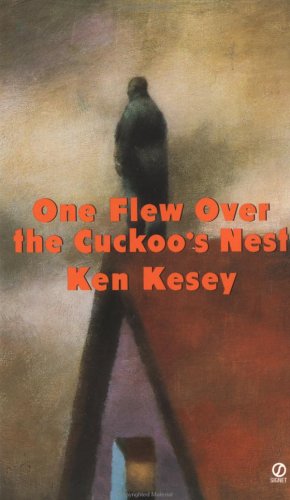
After finishing the reading, I began pondering what topic to blog about as I closed the book and walked over to my computer. I sat down in the chair, placed the novel on my desk, and stopped for a moment as I glanced down at the image staring up at me. I suddenly realized that I had never truly seen the cover of this book. Well, of course I had seen the cover before, but I had definitely failed to ever give the artwork any second thought or consideration before diving in. It seems absolutely insane that I could give so much effort into analyzing and attempting to understand this book without ever even thinking about the only visual aspect provided.  I continued to examine the picture and I became puzzled that the image remained ambiguous and confusing to me despite the fact that I have read over half of the novel it pertains to. The shaded figure facing away perplexes me the most because the large body shape leads to believe it does not depict the narrator, but the lack of hair leads me to believe it also does not depict McMurphy. I do not feel that any other characters have made a large enough impact in the course of this book to make it on the cover, so I am at a loss for whom the figured depicted could represent. Also, the figure stands on top of what looks more like a house or cottage than a mental institution. In my mind the hospital looks more prison-like with a flat, dark gray roof, than a welcoming home with purple, orange and blue. The ward displays the only setting so far in the novel, so I really fail to understand the structure’s relevance to the story. The only aspect of the cover that I slightly understand depicts the figure’s precarious position on top of the pointed roof. This may potentially symbolize the fearful tone throughout the entire book and also evokes an uneasy feeling in me as I worry if the figure will fall or jump off. Also, the figure looking away into the distance elicits a longing feeling that I also feel fits this novel and some of the patient’s wishes to become accepted in society and flee the ward. Overall, this cover still provides considerable confusion and I wonder if the remainder of the book will further explain the images. Or perhaps I am acting crazy and looking too much into it. 

12/9/10

Thank Goodness the Ice Pick Trick Failed to Stick

A few days ago our class became enthralled in a brief and heated discussion on how perhaps we cannot consider the “inhumane” treatments in this novel actually as horrible as they seem because of the time frame and the difference in science between then and now. Despite the fact that I think the Big Nurse acts inhumanely harsh and condescending towards the men at times, I do agree that our ability to grasp this novel may become hindered by our lack of understanding of modern psychiatric science during that time. Even with our brief research on this era, I still feel that no matter how many facts I learn, I struggle to comprehend how medical professionals of the time believed that severing the brain in half with an ice pick actually solved mental problems.

I now realize that my inability to grasp this concept has lead me to feel overly angry with the establishment and defensive of the patients in this book. In an attempt to prevent myself from further skewing the characters in my eyes, I decided to further research the shocking medical procedure of trans-orbital lobotomies that became so famously popular in this time.

These depict just a few of the shocking facts that I found and that I feel help me overcome my disgust and realize how commonly this disturbing procedure occurred:
-In the post-war years between 1939 and 1960, tens of thousands of people were lobotomized in the United States and several other countries.
-The whole procedure only takes three-four minutes and often done hastily and without much preparation.
-For a full one third of patients, the lobotomy had absolutely no effect, and for another third, symptoms actually grew worse. The lobotomy procedure is now known as “one of the most barbaric mistakes ever perpetrated by mainstream medicine.” (American Experience)

This video from PBS gives a complete background and significance of trans-orbital lobotomies and I feel helped me gain understanding of the procedure and psychiatric care of the time period of our novel.
http://www.youtube.com/watch?v=_0aNILW6ILk

12/5/10

Society's Sticky Spot


“Society is what decides who’s sane and who isn’t”(49). This assertion that the narrator boldly states in the beginning of One Flew Over the Cuckoo’s Nest made me pause while reading, and dwell for a moment on the implications.  I believe that this honest, forthright comment speaks the truth and its seemingly insignificant placement in the novel made it impact me greatly.
 Throughout history, many people have wrongly faced consequences of society’s disapproval of their beliefs and have become branded with the label “insane” simply because they failed to meet a certain set of vague standards. Standards which society feels they must enforce in an attempt to keep order and understanding of what it means to have sanity. To me, this seems extremely contradictory because no one truly has the ability to define what a sound, sane mind should or should not believe.  If we did understand this then why were innocent, sane women killed during the Salem Witch Trials because of accusations and Galileo rejected for his accurate heliocentric beliefs? Society tends to place negative focus on those with varying opinions or differing lifestyles than the average person, leading in many cases to false labels and allegations.
 Reading this statement reminded of a story my mom told me about her residency in medical school when she had to spend a serious of sessions shadowing psychologists while earning her degree. She told me once of this one schizophrenic patient that she had a session with who had believed half the time that he embodied Abraham Lincoln. When first hearing this man’s situation, most people automatically brand him as insane and in need of serious medical treatment. This brand leaves no room for the possibility that perhaps he has sanity in relation to his reality of the world, just not in the average perception of the world. Just as Galileo saw the world completely different than anyone else, maybe this man did depict Abraham Lincoln in his own reality…and who can actually define reality? What if society has the ideas of sanity and insanity completely wrong and all those people locked up in asylums truly are the stable, sane individuals and we actually lack sanity?
I believe this theme of society’s power to define people’s mental stability, and the problems associated with this relationship will evolve and emerge as a central theme of this novel.

11/30/10

Inception in CFHS: Glueing Our Ideas to Classmates


Tangible panic surrounded Chagrin Falls High School today as all the AP English 12 students prepared for their in-class essay throughout every period in a sort of scared-out-of-their-minds panic. Everywhere I turned, I saw some stressed out classmate mumbling quotes to themselves like a crazy person, nervously jittering, madly flipping back and forth between worn out data sheet pages, or (my personal favorite) incepting other students. This inception of AP English 12 students apparently does not take much because it seemed to engulf all of our lives today, and I believe that it only requires these 4 simple steps:

     1. An AP English 12 student approaches a fellow classmate in the hall or class and eyes meet as the venting about how stressed they feel begins even before they reach speaking distance.
     2.One of them says their idea of what they predict the essay will deal with.
     3.The other then walks away in a state of panic as they start to obsess over this prediction, until it consumes them so much they feel they must memorize more quotes and analysis dealing with the (probably outlandish and overly specific) prediction their classmate just made.
     4.The incepted student then starts the whole process all over and approaches another innocent victim to incept.

This painful process surrounded us all, and I had not completely realized its relevance and frequency until today as stress about the writing swarmed all over the school. I think that every one of us should rightfully accept the accusation that we, at some point or another, fell guilty to scaring, and ultimately incepting, a fellow classmate in the grueling hours leading up to an in-class essay.

After sitting down in my desk today and scanning the room before the writing, I have concluded that we ended up going into a manageable essay that we had the ability to do, as a group of slightly insane, extremely paranoid, and unnecessarily incepted, AP English 12 students. 

11/28/10

Sticking "The Namesake" and My Christmas Traditions Together


I think one of the reasons our class, and my self included, struggled liking Ashima and Ashoke throughout reading the The Namesake because we could not actually understand their internal conflict of attempting to maintain their own native traditions, while also accepting new ones. Yesterday my family went on our annual trip to cut down our Christmas tree at this place about 30 minutes away called “Whispering Pines”, the same place we have gone for the last eight years or so. While driving there we always listen to the same Bing Crosby Christmas CD, and then once we get our tree we listen to it on the way back as well. Once we get home, my brother and dad trim the tree outside, put it in the stand, and put the lights on it while my mom and I bring the boxes of ornaments and decorations up from the basement. With Christmas music blasting through the house, we all sip on eggnog and sing along while we put up the decorations. We always do the ornaments last and then after we finish everything, we turn off most of the living room lights and sit to talk while looking at the glowing tree for a while. Basically, this day of tradition has remained the same for as long as I can remember, and I cannot explain how upset I would feel if it changed. No one can truly understand how much silly traditions may matter to and impact someone else. So, as I thought about my life in relation to The Namesake (which I do a little too much these days), I finally began to understand Ashima and Ashoke’s situation a little more. I cannot imagine changing this tradition, probably the way they felt about many traditions that began to die when they moved to America. I feel like if I moved somewhere that did not accept listening to Bing Crosby or drinking eggnog, I would not know what to do with myself.  

11/21/10

Pasting Reading into My Routine


I blink open my eyes, reach out my hand, grab my cell phone, and squint to see the bright 9:25 glaring back at me. The attraction of returning to sleep for another two hours tempts me as I lie there for a moment and realize my serious lack of responsibilities for the day ahead. By a wonderful stroke of luck, I did not have to wake up at my usual 6:15 and drag myself to work for seven hours this morning, with the data sheet completed, the English section of my planner reads the word “none”(an extremely rare occurrence), with most of my college apps finished I do not have to dwell on that, and the miniscule rest of my homework, for some strange reason, does not weigh down on me like usual. So as I reach over and am about to turn out the light and take full advantage of my chance for a ‘lazy Sunday’, I see the book beside my bed that has waited patiently on my nightstand for a disgraceful 3 months or so for my time to read it. Recommended by brother over the summer, I remember the day I had taken The Shadow of the Wind from his shelf and put it in my room to remind myself to get around to it one day.  So, instead of grabbing the light switch, my hand veers off course and picks up the book. I feel foolish as I have the instant mental response of “I need a pen to make notes”, because of AP English brain washing, as I suddenly realize how long it has been since I last read a book just for fun. Two hours fly by and I set down the book at 11:30, with a good start and a satisfied feeling of accomplishment as I walk down to get breakfast and my mom’s comments on how I slept late today just enhance my content feeling. With everything going so fast and free time as the seven hours allotted for sleep, the rare occurrence of a moment for something as simple as reading really deserves serious cherishing. Slowing down and taking time for reading depicts a great challenge, so Gogol…good job. 

11/16/10

Gogol Unsticks From Past in Final Line

"Often time it happens we live our lives in chains and we never even know we have the key". This line of lyrics from The Eagles’ “Already Gone” embodies one of my all time favorite song quotations. 
These lyrics popped into my head during discussion today as we talked about the last line of this book and the class began to debate over our satisfaction with the end of this novel. The class seemed almost perfectly divided with defenders and detesters of Lahiri's closing sentence, "for now, he starts to read"(291). I think that despite our satisfaction with Lahiri's ending choice, Gogol's life, or even the plot of the novel overall, this last line undoubtedly draws a full circle ending that shows Gogol's step towards self improvement and maturity. I felt satisfaction at the end because Gogol seemed to realize that life depicts exactly what you make of it, and he took the conscious effort to mature through reading this important book concerning his identity. Throughout chapter 12, Gogol began to realize that the only person chaining him down and preventing him from finding the key to happiness in his life was himself. In this last line he finally abandoned his resentment of his culture, name, and parents, and he took the first small step and read the book. Lahiri's use of "for now" implies that in order to change, one must take initiative and begin the process, just as Gogol took at the close of this novel. Maybe because I had these lyrics in my head throughout the class, but I felt proud of the main character and hopeful of his future as the book concluded and he came to the realization that he had the key to his chained life and he began towards improvement. 

11/11/10

Unfair Blame in Chapter 10's Sticky Situation

I turned on the television tonight after work to watch an episode of “The Office” before starting my homework, and by shocking coincidence “The Chump” episode was playing. In this episode Michael discovers that his girlfriend Donna has a husband and he struggles throughout the episode with defending his actions, and then finally realizes his shame and breaks it off with her at the end. This seemed a little too relevant to chapter 10 of The Namesake to not blog about how this made me realize how our class discussion today overlooked the fault of Dimitri in the unfaithful situation. After writing our journal about our current perceptions of Moushumi, I found myself, like most other people in our class, thoroughly frustrated and disgusted by her actions and decisions throughout the chapter. After watching this episode of “The Office” though, I realized how half of this frustration should become more focused on Dimitri, and I became angry at Lahiri’s minimal involvement of details on this minor, yet extremely integral, character. Most of our hatred towards Moushumi seems justified because of her betrayal of the main character in this story, but a portion of this detest becomes skewed unfairly to her due to the lack of details about Dimitri. The reader overlooks the “man who is enabling her to wreck her marriage” and his fault in the whole situation (266).  This realization actually made me loathe Moushumi a little less as some of the disapproval I felt towards her shifted to Dimitri and his revolting apathy towards ruining Moushumi’s life. Though Moushumi makes this choice to cheat on Gogol, I now realize that Dimitri also plays a role in her unfaithfulness. Unlike Michael from “The Office”, Dimitri continues the affair without question, indirectly characterizing him as inconsiderate and impulsive. I believe that both these characters deserve equal reproach, and Lahiri makes this nearly impossible by focusing the entire chapter on Moushumi, while barely mentioning any background information about Dimitri. This makes my hatred seem biased and I wish that the author chose to better distribute the blame by giving equal details on both Moushumi and Dimitri. 

11/10/10

Stuck On Last Names: Chapter 9 Discussion Reflection

     During our class discussion of chapter 9 today, we spent considerable time dissecting and criticizing various characteristics and decisions of both Gogol and Moushumi, and further analyzed our perceptions of these two characters. At one point our discussion focused in our Moushumi's choice to keep her last name and how "the thought of changing her last name to Ganguli has never crossed [her] mind"(227). When asked whether we believe that women should adopt their husband's last name after marriage, many people agreed that they should to show commitment and honor this tradition. I did not get a chance to voice my opinion today in class about my disagreement with this statement. I do not think that simply a name shows commitment, actions do. I do not at all feel against women adopting their spouse's last name, I do agree that it makes a couple seem more cohesive and together, but I believe that admonishing a woman for her decision to keep her maiden name seems outdated and close-minded. A common last name serves the same purpose as marital rings, they simply depict symbols for the relationship, not actual indispensable factors that would cause a loving relationship to crumble in their absence. In the context of this novel, Moushumi's refusal to accept her title of Mrs. Ganguli only seems disturbing to the reader because it personifies her indirect characterization throughout this chapter as distant and detached from her and Gogol's relationship. With the larger occasion of gender equality in modern day America, I do not think that Moushumi keeping her own last name seems disturbing, I think that her disgust towards this idea, which foreshadows further relationship conflicts, seems bothersome. I think that women, even Moushumi, deserve societal approval in the choice to keep their own surnames because men do not even have to make this choice, and why should different genders abide by unequal standards?